Reviewed on:
Switch 2
Platform:
PlayStation 5, Xbox Series X/S, Switch, PC
Publisher:
Square Enix
Developer:
Square Enix
Release:
Rating:
Everyone 10+
Final Fantasy Resonance makes its strongest case by turning familiar series history into a toolkit for a new cast. Its Vision system folds beloved characters into a flexible progression model, while a focused 40-hour campaign gives the adventure room to breathe without asking for a sprawling commitment. My read is that Resonance succeeds because it treats its callbacks as ingredients, not as the whole meal.
A mobile story given a distinct identity
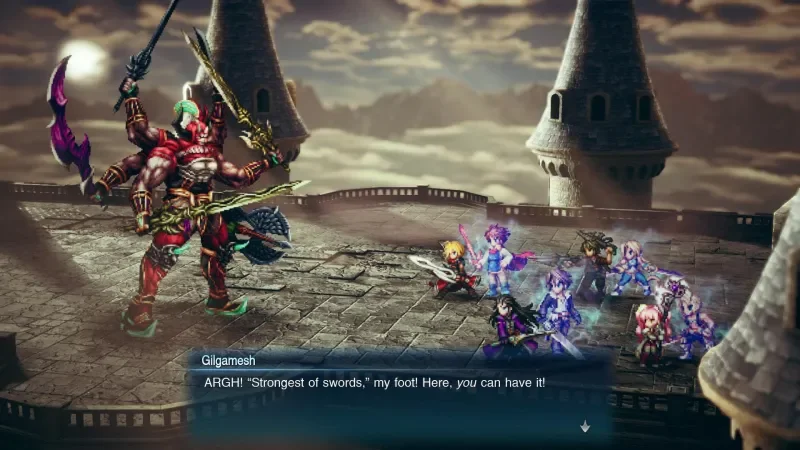
Square Enix built Resonance from the first season of Final Fantasy Brave Exvius, the mobile game that ran from 2016 to 2025 and spanned four chapters. This is a substantial reworking, not a straight port. The HD-2D presentation gives the original sprites more detail, and occasional pixel-art cinematic sequences give the game a visual signature that stands apart from Octopath Traveler and the Dragon Quest HD-2D remakes.
That visual treatment supports a story centered on Rain and his roommate Lasswell. Rain carries recognizable echoes of earlier heroes—Cloud's hair, Tidus's family baggage, Zidane's warmth—but he remains easy to root for on his own terms. Lasswell has a hint of Kain Highwind, yet his difficult sense of duty gives him a character of his own. The rest of the party gradually adds to that chemistry, helped by well-performed comic exchanges and references that reward long-time fans without overwhelming the story.
Visions make the callbacks playable
The game's most effective link to Final Fantasy's past is mechanical. Characters equip Visions—projections of heroes from earlier games—that grant combat abilities, passive upgrades, and transferable skills. Their progression brings to mind Final Fantasy V's job system, while their permanent stat boosts recall Final Fantasy VI's espers. Under the right conditions, a Vision can also unleash a spectacular super attack.
Rain, for instance, starts as a hard-hitting fighter with fire magic. Pair him with Cecil Harvey's Vision and he gains access to light and dark spells; fighting together also develops Cecil's abilities, some of which Rain can equip. That mix of character building and party experimentation gives the system a clear purpose beyond fan service. Players who enjoy shaping a team through interchangeable skills will find plenty to work with.
Combat itself uses a familiar turn-based structure, with the order of upcoming actions visible in the style of Final Fantasy X. Each party member brings a distinct approach and elemental affinity: Lasswell fights as an ice-focused samurai, Jake channels wind through his guns, and Lid attacks with earth-themed machinery. The lineup gives battles enough variety to make team composition matter.
A brisk adventure with a thin connective world
Resonance moves at a welcome pace. Fast travel is readily available, dungeons take a manageable amount of time, and the full journey runs about 40 hours. Random encounters arrive less frequently than in older Final Fantasy games, and their spacing generally keeps grinding optional unless you're trying to fully develop a Vision.
There are trade-offs. The towns look distinctive and offer residents and quest-givers worth meeting, but the spaces between them feel underdeveloped. Dungeons rarely provide much spectacle, and random battles can still interrupt a trip when you're simply trying to reach the next destination. An auto-battle option would have helped ease that friction.
Resonance began with decades of Final Fantasy references, but its own characters and systems are what make it memorable. The result is a compact RPG with expressive art, satisfying customization, and a party worth spending time with. Its world could use more texture; its central adventure already has enough personality to make this a strong recommendation.

