
This review contains spoilers for the film You Can See Everything.
A version of this post originally appeared in Eater Today, which spotlights the freshest news and stories from across the food world every day. Subscribe now.
A bowl of eggs becomes one of the sharpest pieces of evidence in You Can See Everything, Nathan Fielder and Lance Oppenheim’s nearly three-hour documentary about Elizabeth Holmes. The scene offers no confession or clean revelation. Instead, it captures a brief shift in control that takes on new meaning as the film’s portrait of Holmes’s partner, Billy Evans, grows more troubling.
The filmmakers spend the first part of the documentary inside the rental home Holmes and Evans share, recording the weeks before Holmes is due to report to federal prison. Holmes presents herself as a sympathetic figure whose conduct at Theranos has been misunderstood and whose intentions, she says, were directed toward helping humanity. At moments, the film makes that account feel plausible. It also keeps enough distance to leave viewers unsure whether they are seeing candor, performance, or some unstable combination of the two.
A small gesture with a long afterlife
During breakfast, Holmes beats eggs in a bowl with a fork while Fielder interviews her. Her movements are slow and light. The camera stays with the task. Then Evans’s hands enter the frame. He takes the bowl and fork from her and whips the eggs with more force, without first asking to take over.
It’s an ordinary domestic moment, the sort that might pass unnoticed in another film. Here, the interruption is hard to ignore. Fielder asks Evans why he grabbed the bowl. Holmes explains that Evans dislikes the way she mixes eggs and believes he can do it better. She doesn’t object; she supplies a rationale for his action.
That exchange leaves room for more than one reading. Evans may simply be impatient or particular about breakfast. Yet taking a task out of a partner’s hands without asking carries a quiet assertion of authority. Holmes’s easy explanation could suggest that she’s used to the dynamic. Or perhaps she is deliberately making herself look inept so Evans will finish the job. The scene can’t settle which interpretation is right, and its value lies in how neatly it opens the question.
That ambiguity fits the film’s larger method. Fielder often gives disproportionate attention to small details, then lets them alter how a viewer understands what came before. The egg beating initially plays as an unguarded glimpse of a couple at home. Once the documentary reveals more about Evans, the moment looks less casual.

Evans becomes harder to read
The film’s second half finds Holmes in prison and shifts attention toward Evans. He holds power of attorney over her and has used her X account to publish strange, profanity-filled posts that seem unlike her public manner of speaking. The contrast changes the apparent meaning of the breakfast scene: Evans’s intervention starts to resemble an early sign of someone accustomed to acting on Holmes’s behalf, and perhaps over her.
Other details deepen the unease. Evans appears willing to license Holmes’s image for billboards tied to another entrepreneur’s fixation on Theranos. The film also raises the prospect that her AI-generated likeness could be used for pornography or other material she might oppose. His on-camera presentation as a protective partner becomes difficult to square with these choices.
Still, the documentary doesn’t answer whether Evans is exploiting Holmes, following her wishes, or pursuing an arrangement they both accept. Holmes’s own position remains just as unclear. The film presents her as potentially subject to control, but leaves open whether she knows about Evans’s actions and whether she approves of them.
Her account of Theranos adds another layer. Holmes says former boyfriend and business partner Sunny Balwani manipulated her, while maintaining that her goals were beneficial despite the harm caused to investors and patients who received unreliable test results. The film provides no simple way to determine whether she believes that version of events or knows how to make it persuasive. It also leaves viewers to consider how her relationships may have shaped who took responsibility for the company’s actions.
Watching people who know they’re watched
Fielder and Oppenheim build their documentary from competing kinds of evidence. There are Holmes’s and Evans’s statements, their choices, and what they appear to be planning, including a possible Theranos successor called Haemanthus. Alongside those details sits Fielder himself: a filmmaker and performer known for pursuing strange premises with a straight face and pushing situations beyond ordinary documentary boundaries.
That history makes him another uncertain presence. Some moments invite questions about whether Fielder feels a personal or sexual attraction to Holmes, and whether any such interest would be sincere, part of a performance, or both. The film doesn’t clarify where his role ends and his persona begins. His willingness to remain inscrutable mirrors the uncertainty surrounding the people he films.
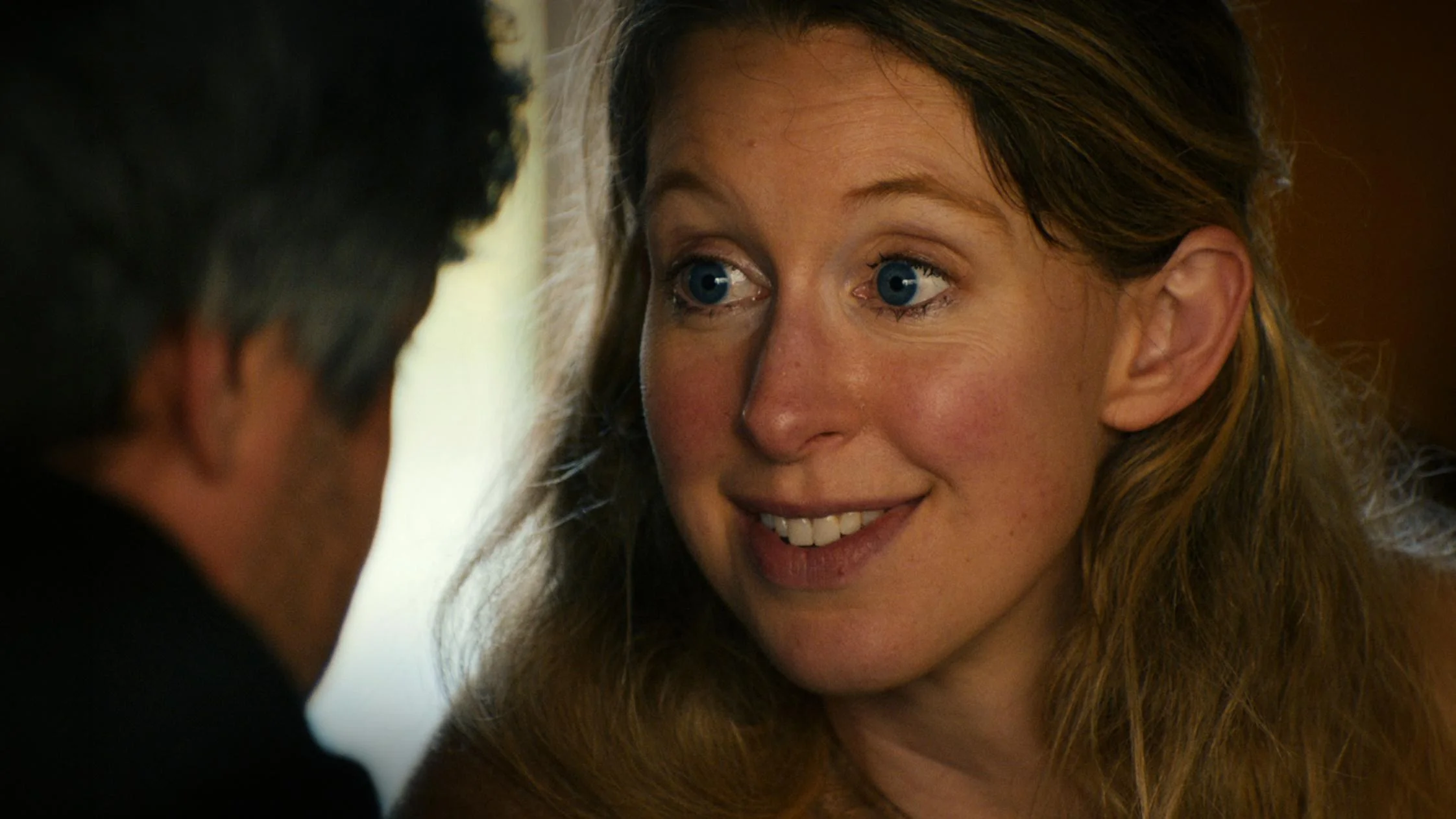
The most telling passages often appear to escape the participants’ control: a fleeting expression, a peculiar phrase, a gesture across the kitchen counter. Yet even those fragments aren’t transparent windows into anyone’s mind. Holmes and Evans know they’re being filmed, and the audience has to weigh every visible reaction against the possibility that it is deliberate.
That’s what makes the documentary’s title feel less like a promise than a provocation. The camera records a great deal, but seeing behavior doesn’t automatically explain it. In the egg scene, Evans’s hands tell us he wants to take over; Holmes’s response tells us she accepts or accommodates the interruption. Neither gesture explains why.
You Can See Everything makes a strong case for Fielder as more than a director of awkward comedy. His attention to mundane behavior gives the film a way to examine how people negotiate control, loyalty, and self-presentation without relying on a definitive revelation. The breakfast exchange stays with the viewer because it is so modest—and because, as the film’s later turns show, its meaning can keep changing. The practical lesson is to watch closely, while resisting the assumption that close observation will make other people easy to understand.