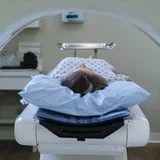
A clear scan can bring relief, but getting to that result may mean facing a familiar stretch of fear. For people who’ve had cancer, routine imaging can revive the emotions of diagnosis and treatment, even when they feel ready to move on. That tension has a name: scanxiety.
Ali Heitz knows how sharply the feeling can return. A year after her breast cancer diagnosis, she went to the hospital for a check-up MRI after months of treatment. She’d expected to feel eager to finish the appointment and hear that she was cancer-free. Instead, entering the MRI machine brought the anxiety of diagnosis rushing back.
“It’s almost like you’re transported back to that week you were diagnosed, and you forget you’ve gone through it all already,” she tells Popsugar. “You go through [the feelings] all over again.”
Why a scan can carry so much weight
The term “scanxiety” was coined in 2011. A paper in Cancers describes it as distress or anxiety before, during, or after cancer-related imaging. For people with breast cancer, monitoring can involve mammograms, ultrasounds, and MRIs during treatment and for years afterward.
There’s no precise figure for how many people experience scanxiety. But the accounts of patients and clinicians suggest it’s common, and it can take different forms. Clinical psychologist Chloe Carmichael, PhD, says fear may center on the scan itself, the possibility of bad news, or memories tied to cancer.
The procedure can be stressful even without that emotional history. Irene Morae Kang, MD, medical director of women’s health medical oncology at City of Hope, points to MRIs, which may require someone to lie still in a confined space for an hour or longer. That can be difficult for anyone with claustrophobia. Sheree Santos, a two-time breast cancer survivor and City of Hope patient, says the discomfort combines with her high blood pressure and “white coat syndrome”—anxiety around doctors.
For other patients, the uncertainty is the hardest part. A scan is meant to check whether someone is OK, but the reason for checking is that something might be wrong. As Kang puts it, that thought can be brief or “quite intrusive.” Even preventive imaging can stir anxiety for people whose families have faced cancer, Carmichael says. In some cases, fear becomes strong enough to make scheduling a check-up feel difficult.
Follow-up scans can also reopen the experience of treatment. Heitz says she understands that she could face cancer treatment again, but she also remembers exactly how hard it was. The emotional effects take time to settle, and each person processes them differently. After diagnosis, she says, it can be hard to trust that your body will keep cancer away.
For some breast cancer patients, monitoring is especially frequent. Kang says people with stage four or otherwise advanced breast cancer may have scans every three months to assess whether their cancer remains under control on the current treatment. Repeated checks can mean repeatedly confronting the possibility of recurrence or progression. For people with a breast cancer history, information about care for someone with stage four breast cancer reflects the different demands of living with advanced disease.
Make the appointment easier to face
Kang says scanxiety often eases over time, though it may not disappear—especially during the transition from active treatment to survivorship. The first step, Carmichael suggests, is to identify what’s driving the feeling. If a scan is bringing up wider or persistent fears, a mental health professional may help address them. If the procedure itself is the main source of stress, practical strategies can make the day more manageable.
Use distractions with a plan
Carmichael recommends choosing five healthy distractions in advance. That could mean watching a show, getting a massage, or asking someone close to accompany you. Santos says Pilates, yoga, dance, and time with friends help her. After a scan, she tries to avoid dwelling on it by exercising or making plans with family or a friend.
Let the feelings be there
Kang says research supports mindfulness and mind-body practices for people going through cancer, making them a reasonable option to try around scans, too. Meditation before an appointment—or as a regular practice—may help. Heitz has found meditation and breathwork useful while working through her experience. She tries to sit with her emotions rather than push them aside: “If I need to cry, I will cry.”
For readers interested in trying meditation, these free meditation apps and websites are one possible starting point.
Choose a phrase that steadies you
Carmichael says the way people talk to themselves can shape how they experience a scan. She recommends preparing a specific phrase to repeat when fear spikes. Someone in remission might remind themselves, “I’m strong, I’m healthy, this scan is just to confirm that things are as they should be.” During treatment, a grounding thought could be, “I’m in the safest place imaginable. I’m in the right place to get the care I need.”
Santos says her faith and naturally positive outlook help her approach scans with hope. That kind of phrase isn’t a promise about the result; it’s a way to give the mind something steady to return to while waiting.
Ask your care team what to expect
Patients don’t have to manage uncertainty alone. Kang encourages people to tell their doctors what worries them and ask what support might be available before the scan. It’s also useful to discuss how results will be shared. Some people want to see results as soon as they’re ready; others would rather hear from a clinician who can explain them in context.
Patients can ask when to expect results and whom to contact with questions. A conversation before the appointment can clarify the process and give the care team a chance to respond to specific concerns.
Bring someone into the experience
Carmichael says social support can help when someone feels afraid or exposed. That support might come from a friend or family member at the appointment, or simply from someone who knows when the scan is happening and checks in afterward. Heitz says asking friends for help and telling her family when she feels scared have mattered throughout her cancer experience. She credits her mother’s positivity with helping her keep going. Kang also notes that counseling can be useful when it’s available.
Keep the fear from keeping you away
Scanxiety is a natural response to a stressful experience, not a personal failing. Kang says healthcare teams should pay attention to the patient’s emotional experience alongside the disease being monitored. That might include mindfulness programs or a clinical setting that feels less frightening, she says.
Support can make an appointment easier to manage, but Santos’s message is direct: get recommended scans even when they’re unsettling. Her breast cancer was detected at stage one through routine screening. She says she has followed recommended screening schedules and feels grateful for the tests.
Heitz’s one-year scan confirmed she was in remission. The relief didn’t erase the anxiety that came before it, but the experience helped her refocus on living in the present. For patients facing their own appointments, the practical takeaway is to tell the care team what would help, bring in support, and keep the scan on the calendar.
Kristine Thomason is a lifestyle writer and editor based in Southern California. Previously, she was the health and fitness director at mindbodygreen, and the fitness and wellness editor at Women's Health. Kristine's work has also appeared in PS, Travel + Leisure, Men's Health, Health, and Refinery29, among others.