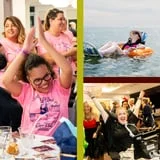
For young women living with ALS, a room full of people who already understand the day-to-day realities of the disease can change the feel of a gathering. At Her ALS Story’s fifth annual retreat, 41 women came together on Cape Cod for wheelchair races, beach time, glam sessions, a drag show and late-night dancing. The weekend made room for grief, too. Its value, by the accounts of attendees, was that nobody had to explain why they needed help before joining in.
That kind of ease can be hard to find in support groups where the experiences and timelines of participants differ. Her ALS Story brings together women diagnosed young, many of whom were building careers, planning weddings or looking ahead to milestones when ALS interrupted those plans. For them, support means more than discussing symptoms. It means having peers who understand both the practical demands of the disease and the loss of the future they expected.
A gathering where help is understood
Kate Nycz, vice president of Her ALS Story, chose Cape Cod for the retreat. By its fifth year, she knew the group’s presence could draw attention from local guests and staff. But she sees that attention as a chance to show disabled people taking part in a celebration, rather than being treated as objects of pity. “Local guests and staff are staring, but it's in a good way. They're seeing disability having fun,” she told Popsugar. “Not that look of pity and, 'Oh, poor thing, she's so young.' I fucking hate that.”
For Monique Green, the retreat’s most important feature was the familiarity among the attendees. As Her ALS Story’s celebrations lead, she helps shape the group’s events. At first, she says, she guarded her privacy: “I always say, 'No new friends,' because I don't like to have to explain what happened to me or what my life was like before I had ALS.” Among people facing similar circumstances, that explanation wasn’t required. “Being at the retreat, it's not like you're on display because everyone surrounding you is going through the same thing.”
Image Source: Liz Linder Photography
Kim Trautman, the group’s community lead, described a more practical version of the same understanding. She has a tracheostomy and cannot speak, and she has a feeding tube because swallowing is difficult. In an ordinary setting, she may need to explain those needs. At the retreat, she said, other attendees knew how to help with a meal, find a reusable straw, locate a feeding tube extension or switch on a suction machine. “Someone is always there to help, no questions asked.”
That support changes what people can do together. A disability accommodation can be more than a tool for getting through the day; it can make participation possible without turning every need into a public conversation. The retreat’s shared knowledge let attendees focus on being together, while help was available when someone needed it.
Making room for celebration
The weekend’s program paired that practical care with deliberately joyful activities. There were wheelchair races and glam sessions, followed by a drag show and dancing. Green couldn’t move her arms, but other women helped her join the party. “At least three people came up to me and grabbed my arms and waved them in the air and helped me dance,” she said. “It was just awesome to feel like I was a part of the celebration.”
"It was just awesome to feel like I was a part of the celebration."
The image of a friend lifting another person’s arms to help her dance is a small example of what the gathering made possible: shared fun that adapted to the people in the room. The women didn’t need to set aside their physical realities to celebrate. They found ways to celebrate together within them.
For Trautman, the dancing also offered comfort after the death of her close friend Katie. At the retreat, she danced with Katie’s young daughter. “The amount of grief that I have felt since Katie's passing has been difficult to manage,” she said. Being with the child gave her “some of the comfort, peace, and healing that I so desperately needed.” Joy and mourning weren’t separate parts of the weekend; for Trautman, one helped make space for the other.
Why young women need peer support
Her ALS Story also challenges a familiar image of the disease. Amyotrophic lateral sclerosis, or ALS, is a progressive neurodegenerative disease that damages motor neurons in the brain and spinal cord. It can affect people of different ages and backgrounds, though it is often associated with older white men. About 90 percent of cases occur without a known family history or genetic cause, according to the ALS Association.
Brooke Eby, who was diagnosed in her early 30s, used humor and advocacy to push back on assumptions about who gets ALS. “Guys! If I've taught you anything, it's that ALS affects hot people, too,” she joked. After her diagnosis, she initially focused on surviving. Later, a wedding where she and the bride’s grandmother used the same kind of walker helped her reconnect with joy. She began offering guests rides on her mobility aid. Eby documented her medical journey and died on Oct. 1.
Her story reflects why peers diagnosed young can matter. Nycz was three months from her wedding and five years into a career as a nurse practitioner when ALS changed her plans. She said many support groups include older people who have already had more time to build the lives they imagined. A younger person may instead be confronting the possibility of milestones that once felt close but now seem uncertain. “It was everything looking up and moving forward,” she said.
"It was everything looking up and moving forward."
That difference can make a diagnosis feel isolating even within a support group. Her ALS Story’s founder, Leah Stavenhagen, helped build a community specifically for young women with ALS. Stavenhagen died in February. For Trautman, the group’s work continues in the relationships its members have built and in the way they encourage one another. “It brings me joy when I think about a group of badass, young women empowering and supporting one another in the fight,” she said. “We may not have been able to choose the cards that we were dealt, but we will definitely choose how we will be playing them.”
Remembering members they’ve lost
Celebration at the retreat doesn’t mean skipping the difficult parts. Each year, attendees set aside time to remember members who have died. At the end of this year’s beach day, they wrote favorite memories on dissolvable paper and sent them into the ocean.
Thirteen members had died between this retreat and the previous one, Nycz said. She described the group’s connection to them through the image of the ocean: “Feeling like they're a small part of the big ocean is how I feel about them in the group. Heavy shit, but it feels like I put them into an ebbing and a flowing of grief and joy.”
The losses make future gatherings uncertain. Nycz knows that someone present this year may not be there next time. But the community also gives its members people to call on through anger and sadness, as well as companions for the good days. “They are there to pick me up when I'm sad, celebrate with me when I'm happy, rage with me when I'm fed up,” she said. “These women deserve all my fight.”
For a group living with a disease that can change what each person is able to do, the retreat’s lasting measure may be how much its members can still do together. Shared care makes participation easier; shared laughter and remembrance give that time its shape.
Chandler Plante (she/her) is a staff writer and PS Fit Producer. She has over six years of industry experience, previously working as an editorial assistant for People magazine, a social media manager for Millie magazine, and a contributor for Bustle Digital Group. She has a degree in magazine journalism from Syracuse University and is based in Los Angeles.