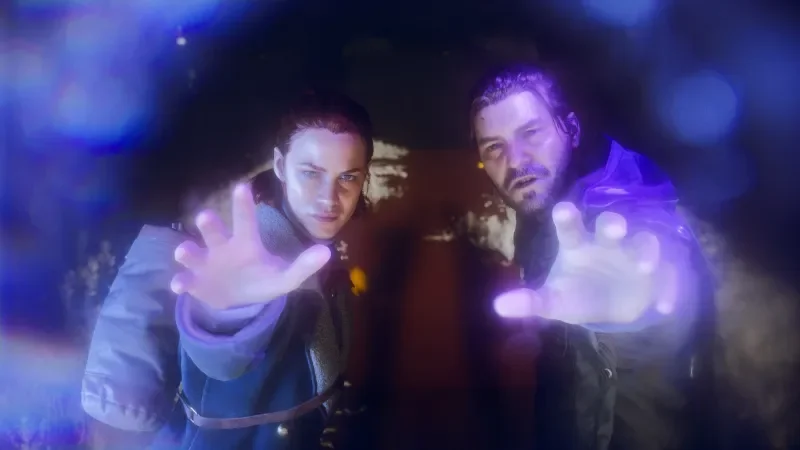
Full spoilers for a late-game sequence in Control Resonant.
Control Resonant’s most striking turn comes when it stops behaving like a third-person action game. Near the final confrontation, the story shifts into a pixel-art, turn-based RPG, using the language of the games Jesse and Dylan might have played as children to revisit the trauma that shaped them. The sequence’s retro style is more than a visual joke: Remedy built it to make the player feel Dylan’s reality breaking apart, then help him reconstruct it.
The result is an intentionally unusual stretch of play, part affectionate homage and part emotional reckoning. Its creators say the team kept it despite concerns that action-game players might resist the detour. In playtests, reactions split sharply, but Remedy added fast travel and skippable sections rather than cutting the sequence down.
A reality break that changes the game
Lead level designer Anne-Marie Grönroos describes the sequence’s starting point as an attack on Dylan’s mind by the Hedron. His sense of reality fractures, and he must rebuild himself. Remedy wanted that collapse to reach beyond the story and affect the player’s experience, using a shift in form to convey some of Dylan’s disorientation.
The first proposal was a text-based adventure. It would have taken the game back to an early video game form, reflecting how the Patterning was deconstructing Dylan. But Remedy had already used a similar idea in an Alan Wake 2 downloadable-content episode and wanted a different direction.
A separate idea offered a way forward. A level designer had previously suggested a sidequest using JRPG-style pixel graphics, though the concept had not progressed. Grönroos connected that pitch to the late-game story and proposed an old-school role-playing sequence, drawing on the kinds of games Jesse and Dylan could plausibly have encountered growing up. The team responded enthusiastically, though the practical question remained: could they build it with an engine designed for a very different kind of game?
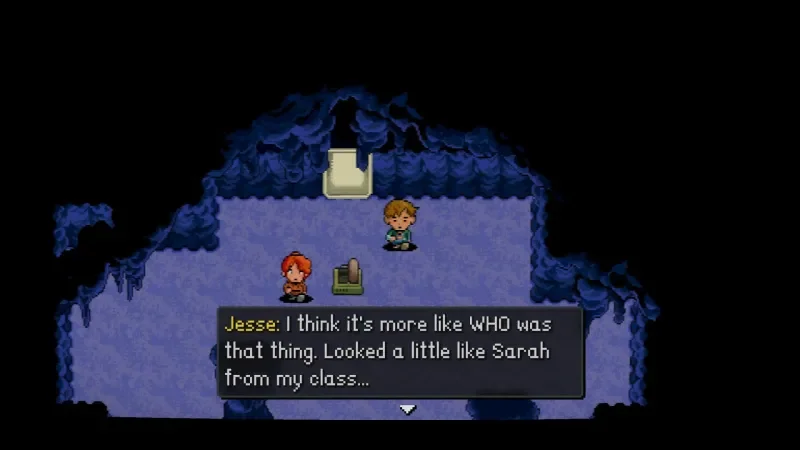
For senior level designer Arhi Makkonen, the creative target was a feeling as much as a list of references. He points to Final Fantasy, Breath of Fire, Chrono Trigger, Secret of Mana, Bahamut Lagoon and Mother as part of the childhood gaming mix behind the quest. The aim, he says, was to recapture a period when games felt like magic—and to let Jesse and Dylan share that memory.
Mother, known as EarthBound in the United States, shaped the sequence’s look. Concept artist Juuso Anttila created the pixel art, whose style suits the game’s small-town Americana setting. Remedy also saw a natural joke in making a story about “Not-Mother” in a visual style inspired by Mother.
A 2D RPG built inside a 3D action engine
The pixel sequence may look like a separate 2D game, but its setting exists inside Northlight’s 3D world. The camera looks straight down at a small, remote area—so compact, Makkonen says, that a full-sized Dylan would have barely fit there. That workaround let Remedy create the overhead perspective without turning Northlight into a general-purpose RPG engine.
The game within the game runs in Lua. Game designer Tommi Saalasti built the underlying system, and Makkonen used it to create the quest. Because Northlight’s tools were made for third-person action, many details had to be handled directly in code: Dylan’s individual steps and turns, the placement of Jesse, and the sequence of dialogue boxes.
Makkonen estimates that the Rebuild quest’s Lua script may contain as many lines as all the other quests combined. The team also worked within tight presentation limits. Animations could use no more than two frames, while some interface elements were assembled from static particle effects. These constraints give the segment its vintage appearance, but they also reflect the amount of bespoke work behind it.
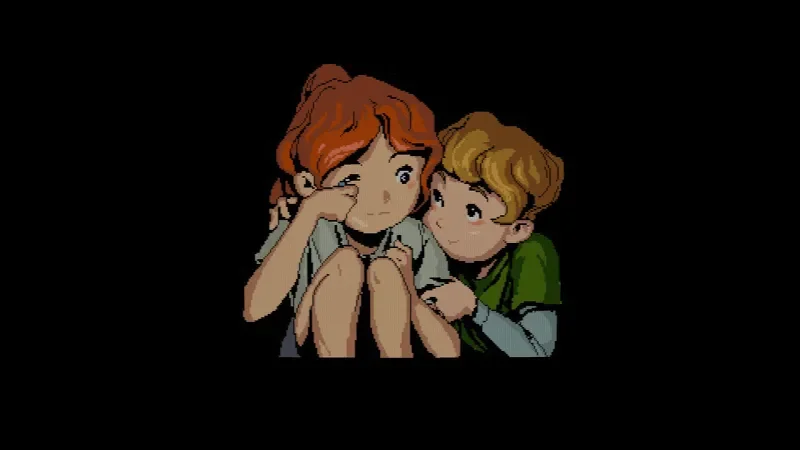 Young Jesse and Dylan as they appear in the sequence
Remedy accepted some rough edges because the story could carry the experience. That choice fits the sequence’s purpose: its mechanics don’t need the depth of a standalone RPG, because the battles themselves help narrate Dylan’s childhood. Encounters show him being tormented by bullies, facing his first fight against rats, and ultimately being abducted by the FBC.
The combat still went through several rounds of refinement. The designers wanted straightforward rules with choices that mattered. Dylan can deliver a powerful attack against one enemy; Jesse can hit every enemy at once. When multiple foes target the same character, defending becomes necessary. These mechanics give the player enough agency to participate in the memories without making the sequence depend on elaborate character progression.
Keeping the detour, with room to move through it
The shift in genre carried a clear risk. Grönroos says the JRPG section was the team’s main concern because it divided playtesters: some loved it, while others disliked it. Remedy considered shortening it significantly, then chose to preserve the version the team believed in while adding fast travel and making some parts optional.
That decision reflects a wider approach to Resonant’s setpieces. Remedy planned several major moments early, but others grew in importance as they took shape. Grönroos cites the Into the Sinkhole quest as one example: it wasn’t originally intended as a tentpole, but the team kept investing in it as it became something special.
The goal, she says, was to give Resonant several memorable sequences rather than let one setpiece dominate the conversation. Some of those moments—including the Sinkhole, Underpass Fault and the JRPG section—lean toward emotional restraint instead of spectacle. The game still has large action sequences, but its quieter turns ask the team to find impact through mood and storytelling.
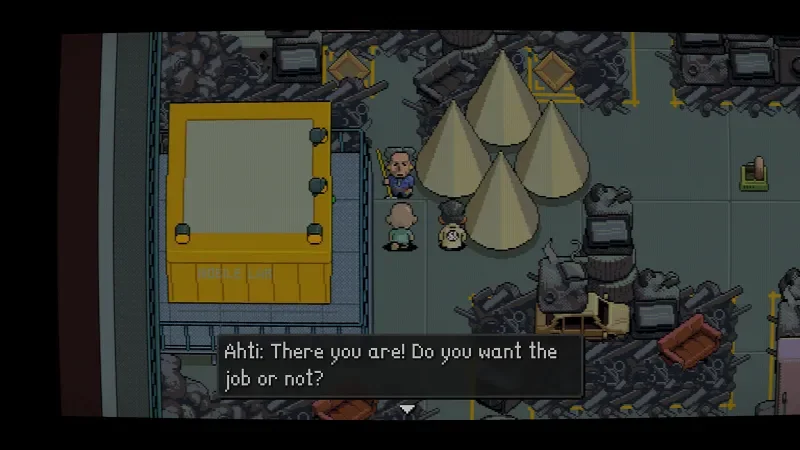 Everyone's favorite FBC janitor Ahti has a cameo appearance in the sequence
Remedy was also aware that pixel art could change how players connected with the characters. Grönroos says the team trusted the writing. Abstraction can create distance, but it can also leave room for players to interpret a character’s feelings for themselves. The small figures and limited animation become part of the storytelling rather than a barrier to it.
From lightbulbs to a cartoon trap
The same appetite for tonal shifts shaped the Underpass mission, where changing lightbulbs takes a paranatural turn. The original concept paired an ordinary maintenance task with increasingly unsettling workplace-safety videos. A live-action maintenance worker would gradually appear too aware of Dylan’s actions, ending with Dylan trapped inside the video.
Grönroos says the idea emerged through a one-hour workshop rather than a formal pitch. The group kicked around the possibility of Dylan changing bulbs as part of a ritual, with sentient safety videos explaining the process and eventually enclosing him. When live action proved impractical, the team switched to the cartoon version now in the game. Grönroos says the pivot made the sequence even funnier.
Across both quests, Remedy’s method is visible: start with a mundane or familiar form, then let the supernatural distort its rules. The JRPG sequence makes that principle personal by tying its retro mechanics to Jesse and Dylan’s childhood. Its lasting effect depends less on recreating a perfect 1990s game than on making an old game format feel like a memory the characters have to enter.
To read Game Informer's review of Control Resonant, follow the link.