Reviewed on: PC
Platform: PlayStation 5, Xbox Series X/S, Switch, PC
Publisher: New Blood Interactive
Developer: Andrés Borghi, Saibot Studios
Release:
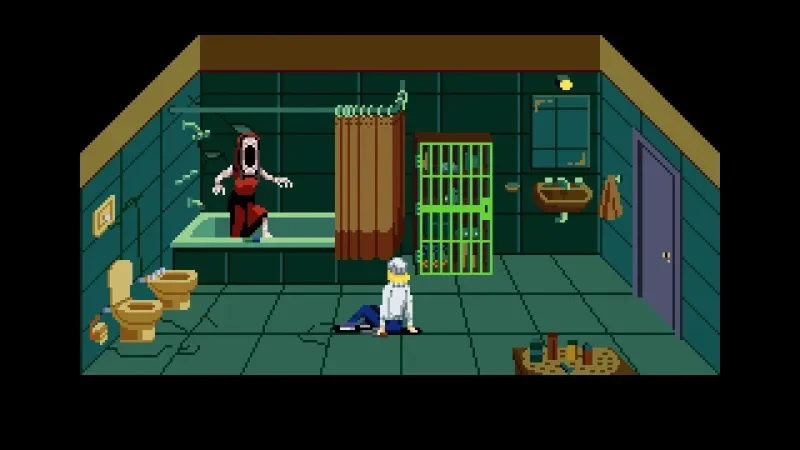
Tenebris Somnia’s best trick is making its live-action horror feel like part of the game rather than a break from it. Practical effects, expressive performances, and visual clues give the filmed sequences a job beyond startling the player: they deepen a compact survival-horror adventure built around exploration and puzzles. The game’s pixel-art world evokes older genre conventions, while the cinematic material gives those familiar spaces a different kind of presence. That combination could easily feel like a novelty bolted onto a retro game. Here, it helps shape the story and the way you read its clues.
A nightmare tied to a broken relationship
Julia heads to her filmmaker ex-boyfriend Ivan’s apartment after repeatedly dreaming that monsters kill him. What begins as a visit becomes a descent through a dream version of the building, where her fears take physical form and the story’s unsettling revelations gather over an eight-hour run. The dialogue-free narrative circles obsession in both filmmaking and romance, giving the horror a personal center as Julia moves deeper into the nightmare. It’s a simple premise with room for ambiguity, and the surprises keep the story moving without making the relationship feel like an afterthought.
Some supernatural backstory gets explained more directly than the imagery requires, which softens the unease at moments when a little uncertainty might have served the scene better. Still, the plot remains legible as events grow stranger. The live-action sequences do much of the emotional work: they’re sharply staged, gruesome without feeling gratuitous, and occasionally provide clues that matter during play. Because the story also concerns a horror film Ivan made with Julia, the scenes create a film-within-a-film effect that reinforces the game’s themes of performance, authorship, and the blurred line between making fear and living through it.
The filmed moments are brief and well placed, from a door-opening scare to scenes that reveal Julia’s fear and resolve. That restraint matters: extended cutscenes could have pulled attention away from the spaces the player is meant to explore, while quick appearances keep the threat close to the action. The actors also give a human presence to a protagonist otherwise represented by a small pixel sprite. Watching them react to the nightmare makes Julia’s journey easier to connect with, even when the story leaves some details for the player to infer.
Puzzles make the apartment count
The entire adventure unfolds across a four-story apartment building, a compact setting that gives the game a clear sense of place. Julia searches rooms for objects, combines what she finds, and follows environmental clues to solve puzzles. Rather than relying on a parade of disconnected locations, the game asks you to notice how spaces and objects relate, then revisit familiar ground with a changed understanding of what might matter. The restrained graphics become an asset: reflections and screens support clever puzzle ideas, and one particularly devious challenge turns the game’s limited save points into part of the problem.
These puzzles ask for lateral thinking without hiding answers behind arbitrary logic. Even when a scenario gets unusual, its clues provide enough footing to make a solution feel earned; the satisfaction comes from making a connection the game has actually given you reason to make. That steady rhythm of searching, testing an idea, and spotting a detail gives the apartment a surprising amount of variety. The building’s limits also suit the story. Its rooms can feel like parts of a place Julia knows and, at the same time, pieces of a nightmare that won’t hold still.
Combat keeps the pressure measured
Fighting grotesque creatures adds a satisfying counterweight to puzzle-heavy exploration. Melee swings and shotgun blasts have deliberate animations that recall older adventure games, yet encounters don’t feel awkward to control. The measured pace makes each fight readable, while limited supplies give even ordinary threats a reason to demand attention. The most intense encounters stop short of becoming exhausting. That balance suits a game whose tension comes as much from uncertainty and scarcity as from reflexes.
Boss battles stand out for their distinct setups: one pits Julia against waves of small gremlin-like enemies, another asks her to defend a fragile effigy, and a third brings her face to face with mirrored versions of a tentacled monster. Each changes the terms of the fight, so bosses don’t feel like simple tests of how much ammunition the player has saved. Health and ammunition stay scarce enough to create tension, though careful players can avoid many ordinary enemies. When supplies run low, the game tends to place ammunition or healing items before the pressure becomes punishing—a practical safety valve that keeps scarcity from turning into a dead end.
A retro horror style with a clear purpose
Tenebris Somnia draws on the mood and mechanics of classic survival horror, but its live-action filmmaking gives the familiar format a reason to exist beyond nostalgia. The pixel-art exploration establishes distance from the actors, then the filmed scenes bring the nightmare back to human scale. This is more significant than it looks: the switch in visual language makes the horror feel like something that has crossed into Julia’s world, rather than just another monster waiting in a hallway. The effect depends on restraint, and the game generally understands that a short, well-placed scene can unsettle more than a long explanation.
The puzzles are inventive, combat is tense without being oppressive, and the performances keep Julia’s story grounded amid the monsters. The direct supernatural explanations occasionally reduce the mystery, but they don’t erase the mood or the clarity of the adventure. If you’re drawn to compact horror games, the appeal here is a focused journey that trusts its setting and uses its unusual presentation to support the experience. A distinctive blend, with a few familiar rough edges.
What the mix makes possible
The game’s strongest idea is also the one with the clearest limits: live-action horror works here because it has a specific narrative purpose. Practical effects can make a creature feel tangible, but the filmed material doesn’t replace exploration or puzzle-solving; it changes how those parts land. Similar experiments in games often risk feeling like interruptions when the two visual styles don’t share a clear purpose. Tenebris Somnia’s scenes fare better because they connect to Julia, Ivan, and the horror film at the story’s center.
That said, the game’s appeal rests on a narrow balance. Players who want constant action may find its measured combat and deliberate searching slow, while those who prefer horror to stay unexplained may chafe at the more explicit backstory. The eight-hour structure helps keep the concept focused, and the apartment gives the story a contained space in which its clues and threats can accumulate. Here’s the thing: the game doesn’t need to reinvent survival horror to make its format choice count. It needs the filmed scenes to earn their place—and most of them do (and this is the part most people overlook).
Score: 8.5

