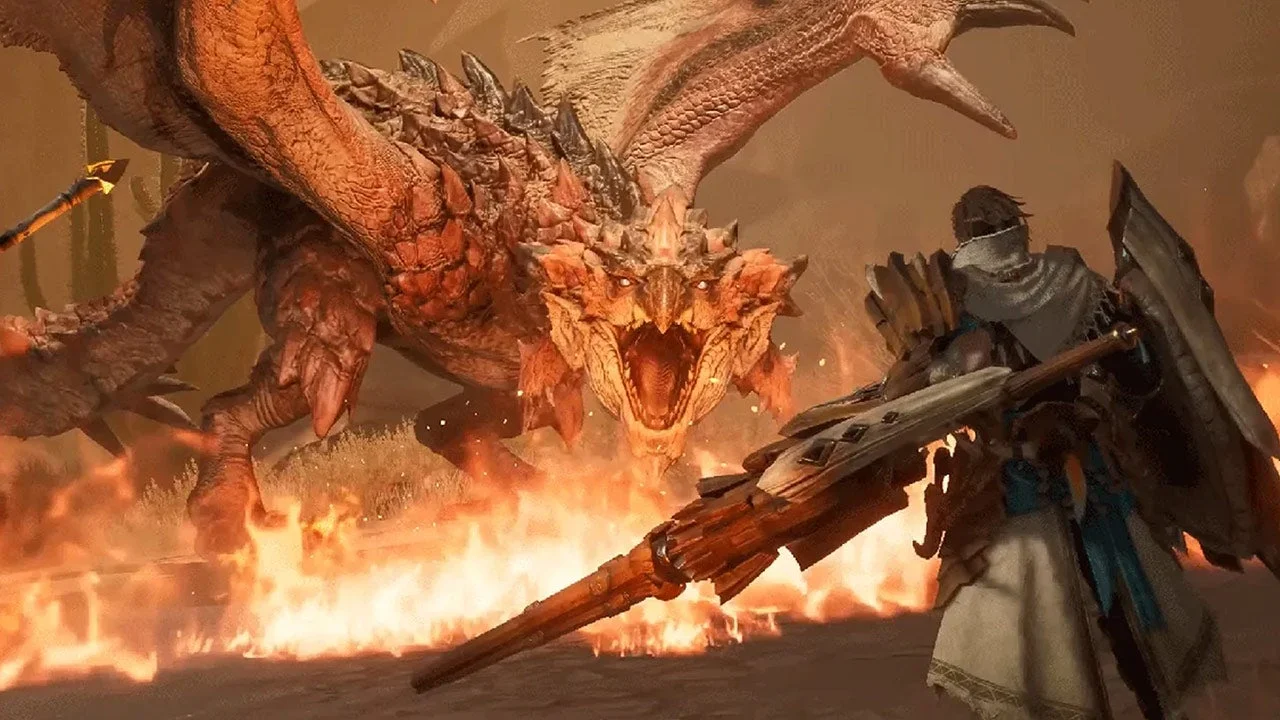
Monster Hunter Outlanders has the scale and familiar hunt loop of a mainline Monster Hunter, yet its mobile economy is already putting pressure on the experience. After six hours, my read is that Capcom’s series has made a surprisingly convincing move to phones: the environments look striking, monsters behave as part of a living ecosystem, and the hunts retain the timing and preparation that give Monster Hunter its identity. The concern is that currencies, character pulls and upgrade materials are beginning to make progress feel like work.
That tension makes Outlanders more interesting than a straightforward mobile adaptation. It hasn’t reduced the series to a smaller set of simplified encounters. Instead, it retains much of the structure associated with Monster Hunter World and stretches progression around the expectations of a mobile game. The result asks players to follow a substantial story, explore a sizeable world and build equipment, while also keeping track of several currencies and development systems.
For fans, that’s a promising foundation with a clear caveat. Outlanders feels built for people who want a full Monster Hunter loop on a phone, but the additional systems may make that loop harder to enjoy as the hunts grow more demanding. Six hours is too early to judge how the balance holds up over time. It’s long enough, though, to see where the game’s strengths and friction points are taking shape.
A familiar hunt on unfamiliar ground
The story sends a group of Adventurer’s Guild explorers to Aesoland, an uncharted island inhabited by Radiant monsters. Their powers have been enhanced by a mineral called Radiantite, which gives the game a reason to alter familiar creatures’ abilities and introduce new designs. Pukei-Pukei, for example, puts more emphasis on attacks aimed at the head or tail—targets that suit Outlanders’ streamlined lock-on system.
Aesoland’s first area will feel recognizable to anyone who’s spent time in World. It’s a dense forest with plenty of vertical routes and places to set up an ambush, and it serves as an introduction to the game’s systems. Hunts still follow the essential Monster Hunter pattern: take a mission, track down a target across an instanced map, bring it down, collect materials and use those materials to craft stronger gear.
Outlanders also gives players a moderately sized open world to roam between hunts. Smaller monsters, crafting supplies and other points of interest help fill the space. Scoutflies lead the way to objectives; players can construct features such as towers and ziplines; and monsters can encounter and fight one another. These details make exploration feel connected to the hunting loop instead of like a separate activity.
The resemblance to World runs deep. Outlanders borrows the broad shape of its exploration and hunt structure, then places it in a new setting with a new story. That familiarity works in its favor: the game doesn’t need to rebuild the appeal of tracking and preparing for a hunt from scratch. The question is whether its mobile-specific systems can support that loop without crowding it out.
Two control schemes, different trade-offs
Combat is where the mobile format makes itself felt most directly. Players can choose Adventure Mode, which reduces the controls to three buttons—Attack, React and Burst—or Classic Mode, which offers more direct control and traditional button-string combos. Adventure Mode handles some actions contextually. React, for instance, can trigger a dodge when a monster attacks or a block when the timing is right.
That simplicity makes Adventure Mode approachable, but it also removes some of the deliberate friction that makes Monster Hunter combat satisfying. Classic Mode preserves more control, yet managing its options on a touchscreen can feel cumbersome. A controller makes Classic Mode a better fit, and controller support is available, but that raises a practical question: if the best experience depends on a controller, what does Outlanders offer someone who already has access to a console or PC version?
There’s no single answer for every player. A phone may be the only device someone has for playing Monster Hunter, and the ability to take hunts on the go has its own appeal. Still, the control choice exposes a compromise at the heart of the game. Adventure Mode makes the experience more comfortable on a touchscreen by automating some decisions; Classic Mode asks for more precision than touch controls comfortably provide.
Recruiting Adventurers adds another layer
Outlanders also lets players assemble a party of story characters and take them along as NPC companions. These Adventurers have distinct movesets tied to particular weapon types, so choosing one changes how combat feels compared with simply equipping a weapon on the player-created hunter. The system creates a reason to recruit different characters and gives solo players a way to bring support into quests and Contracts.
Recruitment uses gacha pulls purchased with Rutacoins. In the opening hours, starting-game currency made it fairly easy to assemble a four-person party. That early access makes the system feel manageable, and the option to hunt with friends or other players remains available. But the longer-term appeal depends on how readily players can recruit new Adventurers and improve the ones they already have. Repeat pulls could become frustrating if a player is trying to add a particular character.
Sidekicks such as Palicos are part of the same recruitment economy. Their presence makes Rutacoins more than a character-collection currency: they connect party building to the broader process of getting support for hunts. The game’s early generosity offers only a first impression, however. It doesn’t yet show how recruitment will feel after those initial resources run out.
Progression is the biggest open question
The traditional Monster Hunter loop already involves gathering materials, managing equipment and planning upgrades. Outlanders layers a larger resource system over that foundation. Zenny pays for items, upgrades and services. Rutacoins fund character and sidekick pulls. Research Points unlock parts of an upgradable skill tree, including additional structures players can build. Other materials are needed to raise character and sidekick levels, increase level caps, improve weapons and craft items.
There’s a familiar satisfaction in working toward a stronger weapon or armor set, and Monster Hunter has always asked players to spend time in menus and gather the materials for a build. Outlanders’ problem so far is the sheer number of parallel tasks. After a half-dozen hours, I’m already feeling the weight of its currencies, upgrade paths and lengthy tutorials. The series’ familiar preparation now competes for attention with systems that serve the game’s mobile structure.
That makes the opening feel slower than Monster Hunter World or Rise. A busy start isn’t necessarily a problem if the added systems make later hunts richer, but it could become a grind if resources turn into barriers. Gacha games can lose their momentum when progress depends on waiting or collecting enough materials to clear the next hurdle. Outlanders hasn’t yet shown whether its later hunts will make the added work worthwhile.
A strong foundation that needs room to breathe
Outlanders is at its best when it lets the Monster Hunter formula carry the experience. The world feels substantial, familiar systems fit together naturally, and the presentation is impressive on a phone. During my time with the game on an iPhone 14 Plus, the frame rate stayed consistent, with very few dips. Those are strong signs for a mobile game built around detailed environments and large monsters.
My early reaction is genuine surprise at how much of World’s scale and structure Outlanders has managed to bring along. The mobile controls and party system give it a distinct shape, but the currencies and upgrade demands are already making the first hours feel dense. The eventual verdict will depend on whether the hunts continue to earn that investment as the challenges grow more complex. For now, Outlanders looks most promising when exploration, combat and crafting stay in the foreground—and the gacha grind stays at the edges.
I’ll be spending more time with Monster Hunter Outlanders before drawing a final conclusion in a full review.