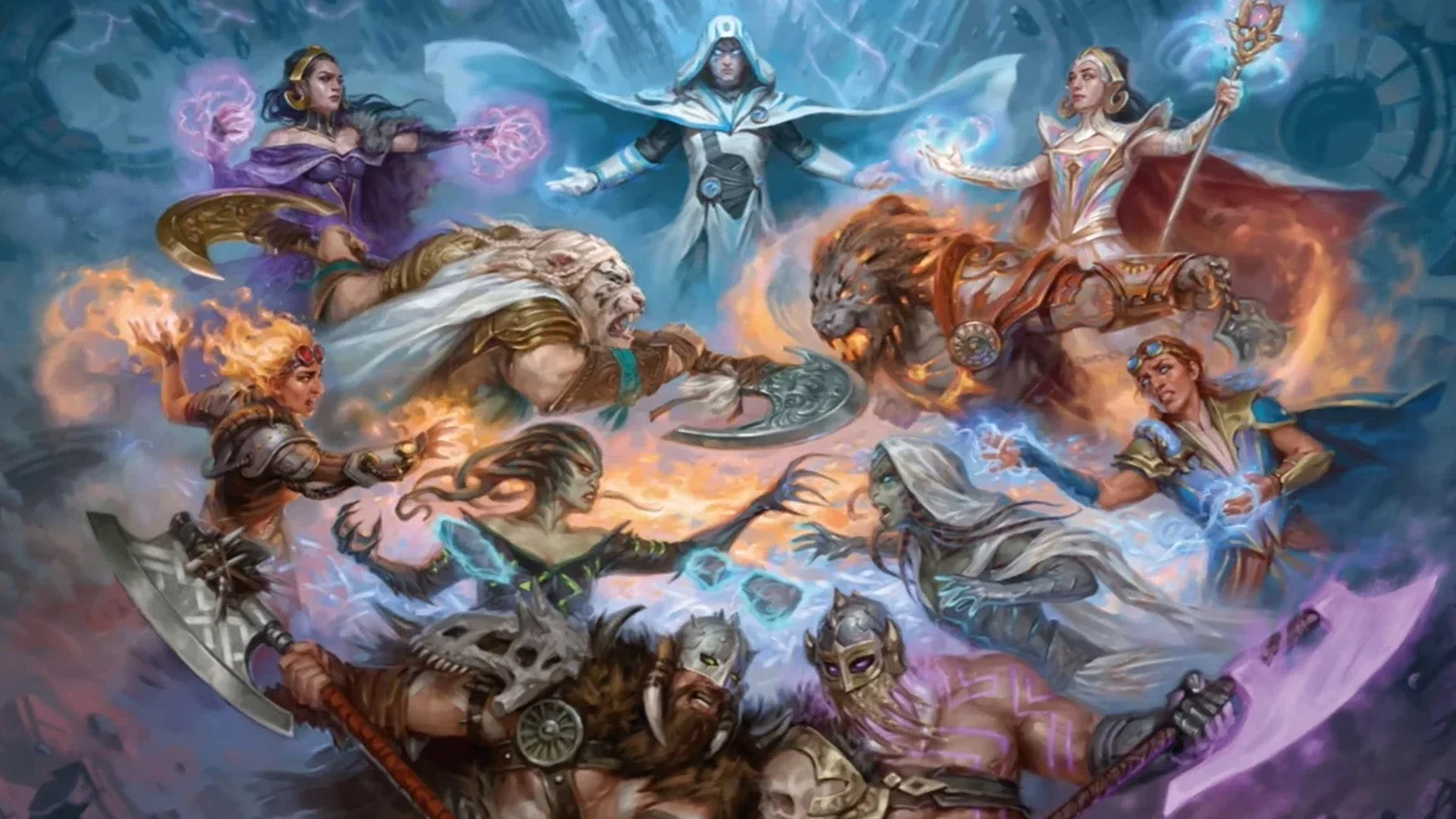
Magic: The Gathering uses Reality Fracture to put a familiar cast through one character’s distorted lens. In the set, Jace Beleren has reshaped the universe to match his own view of how it should work, creating alternate versions of recognizable characters and cards. That premise gives the set a clear organizing idea: its “What If?” variations are tied to Jace’s story, rather than being a collection of disconnected twists.
Yoni Skolnik, a former Magic pro and Principal Game Designer, and Meris Mullaley, Worldbuilding Design Manager, discussed the set’s inspirations, its linked-card approach and a Secret Lair bundle planned for future Magic Multiverse sets. Their account points to a design balancing three demands: making the alternate versions meaningful to longtime players, keeping the cast focused for the story, and building a pack format that could deliver the cards as intended.
A “What If?” rooted in Magic’s own history
Reality Fracture’s closest conceptual predecessor is not last year’s Marvel’s Spider-Man set, but Planar Chaos, a 2007 Magic release. Skolnik said that set explored alternate possibilities by placing effects in colors where players would not usually expect to find them. Reality Fracture draws on the broader appeal of that counterfactual approach while avoiding a return to the same color-pie experiment.
“The concept of What If is very compelling as it lets you pay tribute to Magic’s devoted fan base,” Skolnik said. Head Designer Mark Rosewater wanted to revisit the idea, and the opportunity aligned with the end of Jace’s storyline. That connection gives the alternate versions a narrative purpose: they reflect the world Jace wants, and help bring his arc to a close.
The set’s scope also reflects a deliberate choice about where its characters belong. Mullaley said the team drew on experience from other Magic releases built around multiple legendary characters. It selected people who are, or could plausibly be, active at this point in the game’s timeline, while generally keeping them on their home planes. Rather than gathering a broad multiversal cast on Hexhaven to confront Jace, the design keeps attention on a smaller group and avoids having to explain why each character is present.
That narrower frame supports the set’s central conflict. Familiar characters can appear in altered forms, but their placement still makes sense within the wider Magic timeline. For longtime players, the Echoverse versions offer a different angle on known figures; for newer ones, the choices give the story a more approachable cast to follow.
Three Jaces mark different points in the story
Jace has been part of Magic since Lorwyn in 2007, though he has occupied more of the background in recent sets. Reality Fracture puts him back at the center, both through its premise and through three separate Planeswalker cards. Each version represents a different stage of his journey, charting his growing power and his readiness to carry out his final plan.
Skolnik said the team wanted Jace to remain prominent even for players who only engage lightly with the set. The mechanic Empower Jace helps make that possible. Some cards also become stronger when a player has Jace Planeswalker cards, giving people interested in his longer history a reason to look back through older Magic cards.
The storytelling aims to work at more than one level. Mullaley’s team used recognizable fantasy ideas, including a dark wizard’s tower and an ally who becomes an enemy, to make the premise legible without requiring readers to know Jace’s full history. Art and web fiction carry deeper references for established fans, while the fiction supplies the conclusion to his story.
Skolnik also sees Jace’s identity as a natural fit for the set’s color themes. Jace is strongly associated with blue, whose place in Magic’s color pie is part of how players understand his role. Skolnik joked that many players first learn to think of blue as the “evil” color, making an archetypally blue antagonist an apt choice here.
Linked cards shape the pack experience
Reality Fracture pairs standard cards with Echoverse counterparts, including Karn, Argent Defender and Karn, Gilded Guardian. The paired versions make the set’s alternate-world premise tangible at the card level: players can encounter a recognizable character and its transformed counterpart as part of the same design concept.
Getting those pairs into packs required a change to the number of linked cards. Skolnik said Magic had previously used guaranteed cards from a particular subset, with one legend per pack introduced in Dominaria. For Reality Fracture, the team needed three legends in each pack to ensure the Echoed Pairs could appear, given the printers’ constraints. He said fans have responded well to the resulting packs.
The approach may have uses beyond this set. Skolnik said he expects the team to find another occasion to put three linked cards in a pack. He also clarified that this experiment was not directly connected to planned 2027 pack changes. Together, he said, the work illustrates the production challenge of keeping card design fresh while making products that can actually be printed for a growing audience.
Secret Lair Bundle set to recur
The Reality Fracture Secret Lair Bundle was delayed after the interview took place, but the team said the bundle format is intended to become a regular feature of Magic Multiverse sets. The idea was to bring special bundles together in one package that could be repeated across releases. Reality Fracture’s focus on Jace’s inner sanctum provided a fitting starting point for the product line.
The designers also shared personal card picks. Skolnik singled out both Ajani Planeswalker cards. Ajani Resolute has appeared in Standard lifegain decks, and Skolnik said designing a two-mana Planeswalker was a difficult balancing task he wanted to attempt for a set so centered on Planeswalkers. He also noted Ajani Unrelenting’s performance in draft and its potential in Commander decks built around Planeswalkers.
Mullaley chose Vindictive Triumph, which depicts a moment from the fiction: Liliana resurrects her Echoverse doppelgänger as a lich and takes the fight to Jace. Mullaley said the scene stood out when she read an early story draft and immediately felt it belonged on a card. It’s a concise example of the set’s approach: the alternate versions, character arcs and card designs are meant to reinforce one another. For a release built around Jace remaking reality, that connection is the clearest measure of whether the premise holds together.
Read more about Reality Fracture’s most expensive cards and Magic’s most powerful Commander precons.