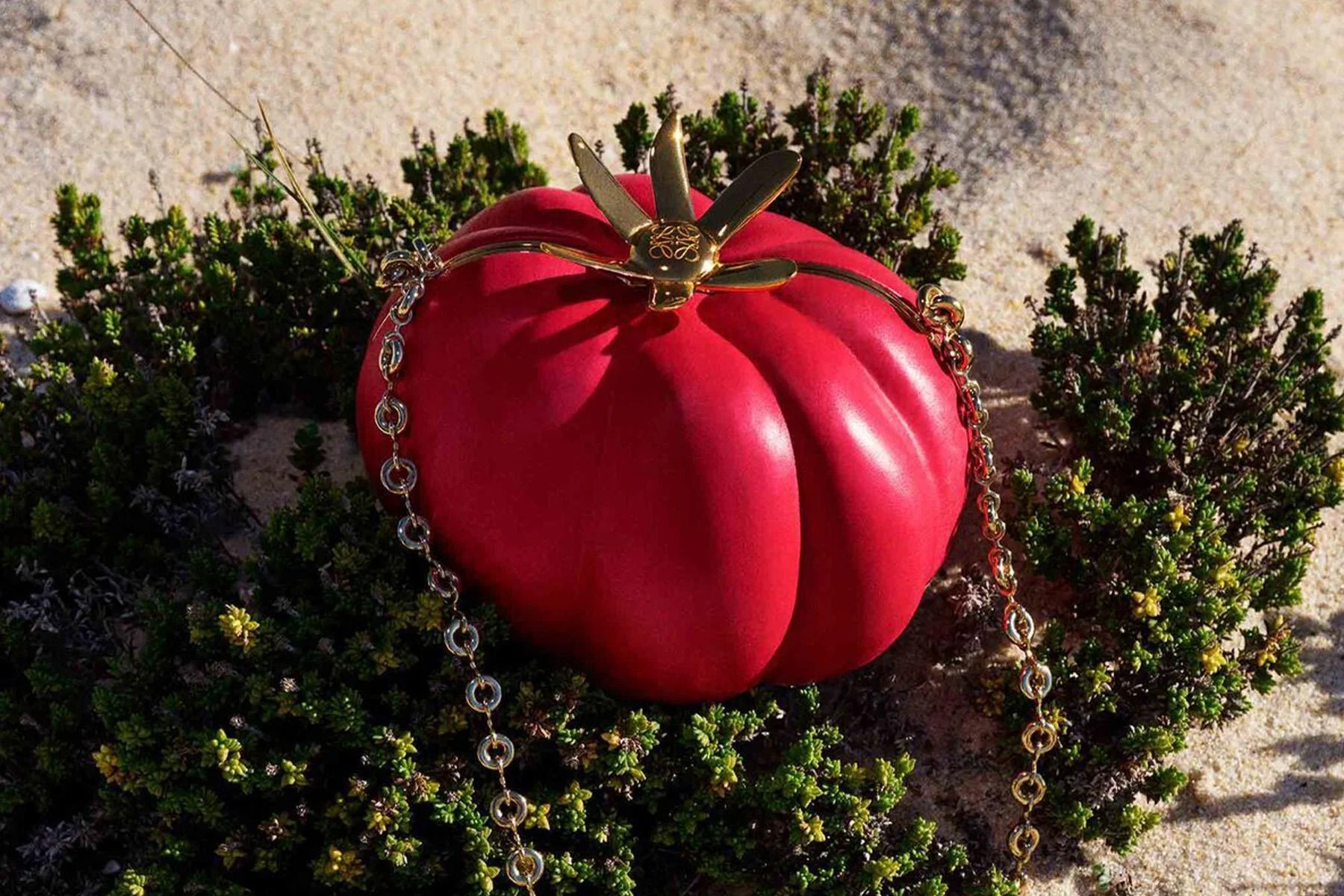
Food motifs have become so common in fashion that a novelty bag shaped like a baguette now feels like an early chapter, not the punchline. Moschino has offered a celery purse; Big Bud Press put hot dogs, beer, wine and pretzels on a jumpsuit made with a Los Angeles bar. Loewe’s summer collection included a $4,150 lambskin tomato clutch, while Walmart listed rotisserie-chicken-inspired purses and charms from $5.97. The range is striking. The harder question is whether these designs still say anything beyond “look at me.”
Fashion has borrowed from food for generations, as the Museum at FIT’s history of food and fashion makes clear. What’s changed is the volume and speed. Food prints, graphics and accessories that imitate edible objects surged during the pandemic, then spread from designer collections to mass-market products. A category once defined by a few clever pieces now risks feeling like a template for the next social-media-friendly release.
From runway joke to retail category
One turning point came in 2020, when Puppets and Puppets sent a black handbag with a chocolate chip cookie attached down a New York Fashion Week runway. The cookie bag traveled quickly online, helped by its simple visual gag and the contrast between a familiar snack and a luxury accessory. Food wasn’t a one-off reference for the label. Its collections included cake-topped aviator caps, Ferrero Rocher heels and cheese hats sculpted in beeswax—objects designed to be recognized at a glance and shared.
That visual clarity connected with Carly Mark’s earlier work as an artist, which centered on candy and snacks. She told Business of Fashion in 2023 that food and fashion made a natural pairing because both, in her view, are driven by pleasure and money. The formula proved effective: an instantly legible image, an unexpected material or placement, and a product with enough humor to travel beyond the runway.
The pandemic also gave food-themed clothing a setting that made intuitive sense. The strawberry dress became a social-media fixture, while Tombolo’s vongole shirt, first released in 2019, reached a high point of popularity in 2021. Vogue featured the shirt in a summer picnic guide; InsideHook described it as an “obvious bedfellow to day-drinks, rooftops and weekenders.” The shellfish print worked as a dress code for a particular kind of leisure as much as a graphic.
Other designs made taste into a visible affiliation. Katie Kimmel’s T-shirts treated chicken-parm devotion like support for a sports team. In 2022, Eater called “seafood kitsch” the look of the summer, as Rachel Antonoff’s seafood-tower dress became a popular item. The designs offered wearers an easy way to signal a favorite meal, restaurant, or kind of occasion. That ease is also what makes the aesthetic easy to copy.
Food as identity—and as status
Food already had a foothold in casual fashion before the current wave. In the 2000s and 2010s, “foodie” culture was taking shape, and apparel leaned into coffee, snacks and the millennial love of avocados. The idea that “you are what you eat” gave food references a social meaning: a shirt could advertise what someone liked, where they went and the company they kept.
Cole Poska, a content creator and partner and creative director at Beyond Studios, sees that attachment as a durable asset for food brands. “Food brands have something most brands would kill for: decades of nostalgia, iconic identities, and consumers who are borderline obsessed with them,” he tells Eater. Poska has reimagined restaurant merchandise for fun, including Cheesecake Factory apparel and a hat inspired by its brown bread. His point is that people bring unusual loyalty to familiar orders and favorite places. A food reference can therefore work as a compact expression of identity, not simply decoration.
But recognizability cuts both ways. Once enough brands have put pasta, shellfish and fruit on garments, the reference can start to look less like a point of view and more like a ready-made route to attention. Bon Appétit asked in 2024, “Why Does Every Dress Have Pasta and Cocktail Shrimp on It?” The question captures the fatigue: a shrimp-print dress may still be fun, but the motif no longer carries the surprise it once did.
The rapid churn of social-media trends raises a practical concern, too. Products built for a quick burst of attention can become disposable just as quickly, especially when shock value does more work than construction or a coherent brand idea. A novelty item needs more than a viral image to earn a place in someone’s wardrobe. Without a reason to wear it after the joke has circulated, its shelf life may be as short as its moment in the feed.
The uneasy economics behind the joke
Food-themed fashion also carries a sharper meaning as groceries become more expensive. Leah Asmelash explored that tension for CNN: a garment celebrating an abundant table can read differently when the cost of food is rising. A $425 cardigan decorated with oysters may have seemed unusually specific a few years ago. In 2026, the motif can feel familiar—and can suggest that its wearer has the money and access to enjoy the food it depicts.
That status signal isn’t limited to expensive clothes. A caviar sweater can imply a taste for culinary luxury; a mass-market imitation sends a different message. A Temu version of a food-shaped purse, for instance, may function like an imitation luxury logo: the visual cue is familiar, but the relationship between product, price and status has shifted.

“Food brands have something most brands would kill for: decades of nostalgia, iconic identities, and consumers who are borderline obsessed with them.”
Cole Poska
Utility and story offer a longer shelf life
A more durable approach can start with the garment itself. Sam Salad, co-founder of Los Angeles apparel company Meals, describes the brand as workwear that “bakes ‘food culture’ into apparel, blurring the lines between the clothes we eat and the food we wear.” Its focus is utility: chef pants with a fuller cut, offered in basic colors as well as restrained references to blue cheese and watermelon. The food idea sits within a functional product instead of carrying the entire design.
Meals began in 2019, when Salad was selling premium denim on Abbot Kinney Boulevard in Venice, among restaurants and food culture that helped shape the label. He says, “Design today has to translate across languages and platforms.” That challenge helps explain why bold food imagery has become attractive: it reads quickly, travels easily and doesn’t need much explanation. Yet a fast-reading concept can still have a point of view. The distinction lies in whether it belongs to a larger design language and whether the object works beyond its first impression.
Salad argues that food is a natural companion to fashion because it’s universal. He points to Issey Miyake presenting pleated pieces as small omakase sets and to the 1937 lobster dress designed by Salvador Dalí and Elsa Schiaparelli. The dress, worn by Wallis Simpson, challenged conventional dress codes and caused a stir in its time. Its later low-cost imitation illustrates how a once-distinctive idea can become a generic motif after it circulates widely.
For brands, the route out of food-print sameness may be to make fewer things with clearer identities and better stories. Salad puts it simply: “We do a few things really well, and that’s enough,” pointing to In-N-Out Burger. Poska’s measure is similar: “I’d rather make one thing people talk about for a year than 20 things people forget about tomorrow.” His closing distinction is apt: “The first person to make a candle look like a stick of butter is a genius. The hundredth person is just making a candle.” Food can still give fashion a vivid vocabulary. The next memorable piece will need more than a recognizable shape; it will need a reason to last.