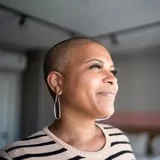
Kommah McDowell, a breast cancer survivor and author of "Silver Lining: Cancer Was the Best Worst Thing That Ever Happened to Me," assumed her memory gaps were ordinary forgetfulness. Then she noticed the blanks reached backward, too. Her past was getting patchy along with her present.
"That's the reality of chemo brain: It affects both my short-term and long-term memory. I could be in the middle of a conversation - or even a sentence - and suddenly, whatever I was trying to say is completely gone, often never to return."
Julia Park Tracey, another breast cancer survivor and author of "Silence: A Novel," calls her own experience "challenging, to say the least." The symptoms hit her hard in ways that are easy to dismiss from the outside.
"I couldn't remember simple words, although I knew what I meant," she says. "I got lost coming home. I forgot people's names. I didn't trust myself to edit any work. I couldn't remember the word for 'tears,' so I called it 'eye saliva.' I was spacey and forgetful, and not capable of deep thought."
The fog is common, and it's also poorly understood. Here's what clinicians say is behind it, and what patients have found helps.
What Chemo Brain Actually Means
"Chemo brain" isn't a medical diagnosis. It's shorthand for the mental fogginess that people with cancer report during or after treatment. The American Cancer Society describes it as trouble thinking as clearly as before, which can show up as difficulty remembering things, finishing tasks, or learning something new.
The name itself is a bit misleading. Wael Harb, MD, a medical oncologist at MemorialCare Cancer Institute at Orange Coast and Saddleback Medical Centers in Orange County, California, says the symptoms are sometimes felt during treatment and especially afterward. "We don't really understand the exact mechanism, but we think it's related to the cancer itself."
Is It Really the Chemo?
Not necessarily. Heather Jim, PhD, co-leader of the Health Outcomes and Behavior Program at Moffitt Cancer Center, points out that patients who never receive chemotherapy can also experience short- or longer-term cognitive impairment. Chemo may be one trigger among several, not the only one.
That matters for how people think about their symptoms. A patient who skipped chemo and still feels foggy isn't imagining it, and a patient who had chemo shouldn't assume the drugs are the whole story.
What Might Be Driving It
Jim says several mechanisms could be involved, including inflammation, accelerated cellular aging, or the cancer treatments themselves. What's less clear is why some patients develop cognitive problems after cancer and others don't.
Non-cancer factors may pile on, too. According to the ACS, stress, anxiety, depression, trouble sleeping, poor nutrition, and frailty can all contribute. That gives patients and their care teams some levers to pull, even when the underlying cause is murky.
Signs to Watch For
The ACS lists these as the most common signs and symptoms of chemo brain:
- Memory lapses
- Trouble concentrating
- Difficulty remembering details like names, dates, and events
- Trouble coming up with ideas, planning activities, and making decisions
- Losing track of one task when trying to multitask
- Trouble learning new things
- Taking longer to finish tasks
- Difficulty finding words
Timing matters, too. Jim says these symptoms tend to get worse when patients are tired, stressed, or trying to juggle several things at once. That pattern is useful to know, because it suggests where to start adjusting.
What Helps in Practice
Krysten Chadwick, an occupational therapist at The Ohio State University Comprehensive Cancer Center – Arthur G. James Cancer Hospital and Richard J. Solove Research Institute Oncology Rehabilitation, says every patient's experience is different, so the options vary. Her core message is that the brain responds to work. "Your brain is kind of like a muscle and it needs to be worked out or managed to get better."
She recommends starting with the basics. Lists and calendar reminders are a "great first step." Beyond that, cognitive training or brain games can help build back some of the mental flexibility people feel they've lost.
Tracey found that scheduling mattered. "I tried to do anything that needed real attention first thing in the day, not later when I was tired," she says. She also learned to plan around her chemo cycle. "I simply did not even try on days one to two of weekly chemo. Days three through six were better for thinking."
She also gave herself permission to rest her brain. "I watched bland TV. I didn't read much, just watched mysteries on TV. Easy on the brain meant less stress, better healing."
McDowell leans on two things: writing things down and the people around her. "Just as important is being surrounded by people I trust - people who know how to gently remind me of things I forget, and who can laugh with me about the things I can and can't recall." She says humor has helped her handle the lapses. In the first five years of her recovery, those moments often ended in tears. Now she tries to laugh through them.
Chadwick's final point may be the most important one for anyone in the fog. Patients should speak up about it. "It doesn't need to be something that you're stuck with forever."
The research on chemo brain is still catching up to the lived experience. But the pattern patients describe, from lost words to planning around fatigue, is consistent enough that clinicians are taking it seriously, and that's the first step toward getting help.